Thursday, December 7, 2017

Digging Up the Bible: An Ivory Cherub

DIGGING UP THE BIBLE
Important Archeological Finds that help Us Understand Scripture
pdf
Linda Manuel—1996
Ivory Cherub from Samaria
(9th century BC)

This ivory cherub is from a cache of over 200 pieces that excavators found in the palace of King Ahab (876-854 B.C.) at Samaria: "As for the other events of Ahab's reign, including all he did, the palace he built and inlaid with ivory..." (1 Kgs 22:39).

All the ivories in the collection represent the Phoenician style and are similar to those from Cyprus, Syria, and Assyria. Some scholars believe Jezebel, Ahab's Tyrian wife, introduced them along with various cult practices to the northern capital of Israel. Tradition identifies human-headed lions with spread wings as the biblical cherubim.

Cherubim are composite creatures, perhaps the most spectacular of the supernatural realm. They appear in the Old Testament numerous times yet only once in the New: "Above the ark were the cherubim of the Glory, overshadowing the atonement cover" (Heb 9:5). Not all cherubim are alike, although they have similar features in each account. When describing them for the wilderness tabernacle, the biblical author assumes the reader is already familiar with the cherubim's appearance, concentrating on their placement over the ark and their relative orientation:
Make two cherubim out of hammered gold at the ends of the cover. Make one cherub on one end and the second cherub on the other; make the cherubim of one piece with the cover, at the two ends. The cherubim are to have their wings spread upward, overshadowing the cover with them. The cherubim are to face each other, looking toward the cover. Place the cover on top of the ark and put in the ark the Testimony, which I will give you. There, above the cover between the two cherubim that are over the ark of the Testimony, I will meet with you and give you all my commands for the Israelites. (Exod 25:18-22)
When describing cherubim for the first temple, the biblical author again assumes the reader is familiar with the cherubim's appearance, specifying the materials and dimensions for their construction:
In the inner sanctuary he made a pair of cherubim of olive wood, each ten cubits high. One wing of the first cherub was five cubits long, and the other wing five cubits—ten cubits from wing tip to wing tip. The second cherub also measured ten cubits, for the two cherubim were identical in size and shape. The height of each cherub was ten cubits. He placed the cherubim inside the innermost room of the temple, with their wings spread out. The wing of one cherub touched one wall, while the wing of the other touched the other wall, and their wings touched each other in the middle of the room. He overlaid the cherubim with gold. (1 Kgs 6:23-28)
Several other passages speak about the LORD "enthroned between the cherubim" (2 Sam 6:2; Ps 80:1; 99:1; Isa 37:16).

The fullest description of cherubim is in Ezekiel's vision of the heavenly entourage that attends the LORD:
In the fire was what looked like four living creatures. In appearance their form was that of a man, but each of them had four faces and four wings. Their legs were straight; their feet were like those of a calf and gleamed like burnished bronze. Under their wings on their four sides they had the hands of a man. All four of them had faces and wings, and their wings touched one another. Each one went straight ahead; they did not turn as they moved. Their faces looked like this: Each of the four had the face of a man, and on the right side each had the face of a lion, and on the left the face of an ox; each also had the face of an eagle. (Ezek 1:5-10)
 Later, the prophet identifies these "living creatures": "I realized that they were cherubim" (Ezek 10:20).

The living creatures in Rev 4 are probably the same beings (cherubim), but John describes them differently from the creatures in Ezekiel. Each has one prominent feature, but all have six wings and many eyes:
The first living creature was like a lion, the second was like an ox, the third had a face like a man, the fourth was like a flying eagle. Each of the four living creatures had six wings and was covered with eyes all around, even under his wings. (Rev 4:7-8)
 Whether the decorative image in Ahab's palace or the "living creature" in John's vision, the cherub is a composite, supernatural being that should be terrifying to the people of God because it serves in the presence of God. 

Significance for Biblical Studies: The Ivory Cherub from Samaria is a reminder that what is evident to the physical senses is not all there is, that we do not live in a closed system but in a realm both natural and supernatural beings inhabit, a collective group we will one day join:
There before me was a great multitude that no one could count, from every nation, tribe, people and language, standing before the throne and in front of the Lamb.... They fell down on their faces before the throne and worshiped God. (Rev 7:9, 11).
For a pdf go here.

Wednesday, December 6, 2017

Digging Up the Bible: The Code of Hammurabi

DIGGING UP THE BIBLE
Important Archeological Finds that help Us Understand Scripture
pdf
Linda Manuel—1996

 
Hammurabi Code
(18th century BC)
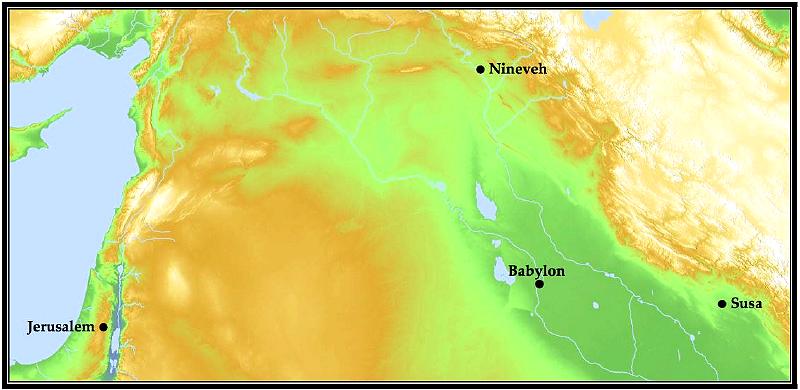
M.J. de Morgan, archeologist and curator of the Louvre (1901), discovered this eight foot diorite stele (an upright slab or pillar, usually with an inscription on it) in Susa where the Elamite king, Shutruk-nehhunte, took it as booty following a successful raid on Babylon in 1160 B.C. The piece was originally created for King Hammurabi and placed in the Esagil temple of Marduk, chief god of the Babylonian pantheon. The prophet Jeremiah mentions Marduk:
This is the word the LORD spoke through Jeremiah the prophet concerning Babylon and the land of the Babylonians: "Announce and proclaim among the nations, lift up a banner and proclaim it; keep nothing back, but say, 'Babylon will be captured; Bel will be put to shame, Marduk filled with terror. Her images will be put to shame and her idols filled with terror.' (50:1-2)
The inscription consists of forty-four columns of laws and specific cases that the king judged. The Code of Hammurabi derives, in part, from the king himself and may date from the beginning of his rule. He commissioned the final edition and compilation on this stele thirty years later.
 
 
King Hammurabi reigned over the city of Babylon from 1792-1750 B.C. An abundance of letters and other administrative documents profile a strong king engaged in direct control over matters of war, diplomacy, and business, yet attentive to the finer things of life such as good food, hunting, and beautiful architecture. Through his conquests, the kingdom grew from a small city-state to include the entire Mesopotamian valley. In his first full year as king, Hammurabi made a public pronouncement of the law which would govern the religious and economic life of his people, much like the "reforms" of Hebrew kings who, by restating allegiance to biblical law in the opening year of their rule, "did what was right in the eyes of the LORD". The code bears many similarities to Sinaitic legislation:

  Hammurabi Deuteronomy
False
witness
If a man accused another man and brought a charge of murder against him, but has not proved it, his accuser shall be put to death.... If he came forward with (false) testimony concerning grain or money, he shall bear the penalty of that case. (1, 4)
1 If a malicious witness takes the stand to accuse a man of a crime...and if the witness proves to be a liar, giving false testimony against his brother, then do to him as he intended to do to his brother. You must purge the evil from among you. (19:16-18)
Parental
treatment
Parental If a son has struck his father, they shall cut off his hand. (195)
Honor your father. (20:12)
Adultery
If the wife of a man has been caught while lying with another man, they shall bind them and throw them into the water... If the husband of the woman wishes to spare his wife, then the king in turn may spare [the man]. (1,29)
If a man is found sleeping with another man's wife, both the man who slept with her and the woman must die. You must purge the evil from Israel. (22:22)
Kidnapping
If a man has stolen the young son of another man, he shall be put to death. (14)
If a man is caught kidnapping one of his brother Israelites and treats him as a slave or sells him, the kidnapper must die. You must purge the evil from among you. (24:7)
 
The origin and purpose of these two legal bodies, however, were quite different. In biblical tradition, God created man for fellowship with Him and gave the law so that, through it, His people could become holy and represent Him to others. Hammurabi recorded the laws and cases on this stele to demonstrate his stewardship and wisdom to his god Marduk. The king displayed the pillar in the temple for Marduk to see, and it remained there for five centuries. Moreover, whereas Hammurabi boasted about his accomplishments, Moses was self-effacing: "Who am I that I should go to Pharaoh and bring the Israelites out of Egypt?" (Exod 3:1 1)
 
Significance for Biblical Studies: The Hammurabi Code ceased to be the law of the land at his death. Our God, however, is eternal, and His laws are "eternal" (Ps 119:160). Moreover, those who keep His commandments will enjoy fellowship with Him "forever" (Deut 5:29).


For a pdf go here.

Tuesday, December 5, 2017

Digging Up the Bible: The Gilgamesh Epic

DIGGING UP THE BIBLE
Important Archeological Finds that help Us Understand Scripture
pdf
Linda Manuel—1996
Gilgamesh Epic
(7th century BC)
This clay tablet with cuneiform (wedge-shaped) script was discovered at the site of ancient Nineveh (modern Iraq), capital of the Assyrian empire, by Austen Henry Layard in 1851 and deposited in the British Museum. George Smith translated the text in 1872.


The Gilgamesh Epic (tablet XI) is an ancient Mesopotamian (Sumerian) poem that chronicles the events of a flood told by one of the only survivors, Utnapishti, to the mythical hero, Gilgamesh.
King Gilgamesh
There were originally twelve clay tablets recounting the adventures of the King of Uruk from the third dynasty of Ur (c. 2100 B.C.). The tale was recorded centuries before Moses wrote the book of Genesis. The document shows a striking resemblance to the biblical account of the flood (chapter 8), as the selections below illustrate. This tablet came from the library ruins of the Assyrian King Ashurbanipal.

Gilgamesh Genesis
When the seventh day arrived, I put out and released a dove. The dove went; it came back, for no perching place was visible to it, and it turned round.
After forty days Noah opened the window he had made in the ark and sent out a raven, and it kept flying back and forth until the water had dried up from the earth. (Gen 8:6-7)
I put out and released a swallow. The swallow went; it came back, for no perching place was visible to it, and it turned around.
Then he sent out a dove to see if the water had receded from the surface of the ground. But the dove could find no place to set its feet because there was water over all the surface of the earth; so it returned to Noah in the ark. He reached out his hand and took the dove and brought it back to himself in the ark. (Gen 8: 8-9)
He waited seven more days and again sent out the dove from the ark. When the dove returned to him in the evening, there in its beak was a freshly plucked olive leaf! Then Noah knew that the water had receded from the earth. (Gen 8: 10-11)
I put out and released a raven. The raven went, and saw the waters receding. And it ate, preening, lifted its tail, and did not turn around.
He waited seven more days and sent the  dove out again, but this time it did not return  to him. (Gen 8:12)

This text, although not identical to the biblical record, probably came from the same source, but in the transmission of the actual account the traditions diverged. There are other texts even older than Gilgamesh that speak about a great flood, yet we believe the story that came down through the patriarchs and that Moses recorded is what actually happened during the time of Noah.

Significance for Biblical Studies: What this document (and others like it) shows is that Scripture was not composed in a vacuum. Biblical authors working through the guidance of the Holy Spirit may have used existing literary sources to compile the historical record we now call the Bible.

For a pdf go here.

Monday, December 4, 2017

Digging Up the Bible: The Gezer Calendar

DIGGING UP THE BIBLE
Important Archeological Finds that help Us Understand Scripture
pdf
Linda Manuel—1996


Gezer Calendar
(late 11th to early 10th century BC)
R.A.S. Macalister discovered the Gezer Calendar in 1908 at the site of the ancient Canaanite city, about seventy miles west of Jerusalem. The inscribed limestone tablet is 4'14" by 2/4". Its irregular bottom edge indicates that a portion broke off before the scribe made this record. Moreover, an examination of the surface reveals an earlier but now indistinguishable use (having been scraped and sanded smooth). The current text, which is complete, fits the available space. The inscription's paleography (study of ancient writing) and orthography (study of ancient spelling) help date the text.
 
 
The writing is paleo-Hebrew, and the text describes the agricultural year in verse form. It may have been an aide for teaching children:
His two months are (olive) harvest
     His two months are planting (grain)
          His two months are late planting
His month is hoeing up flax
     His month is harvest of barley
           His month is harvest and feasting
His two months are vine-tending
     His month is summer fruit.
The significance of this find is not just the insight it offers into early educational material—although it does suggest that literacy may have been fairly prevalent in Israel—but the window it offers into the regular agricultural cycle. For example, reading the book of Ruth against the backdrop of the Gezer Calendar offers perspective on the timetable of those events, that they occurred over several months and not just a few weeks, as the brevity of the four-chapter narrative may seem to suggest: "Ruth went out and began to glean in the fields behind the harvesters. As it turned out, she found herself working in a field belonging to Boaz." (Ruth 2:3)
 
Plowing and sowing began in November, after the early rains, and continued into February. The new grass and herbs sprang up quickly during the later rains of March and April, and farmers either harvested them for fodder or left them for pasturing livestock. Flax was one of these "new grasses" pulled up by hand. Having gathered and stored the fodder, the barley, first of the major grain crops, was ripe. Reaping occupied the months of April, May, and June. Ruth spent at least three months in the fields of Boaz: "Ruth stayed close to the servant girls of Boaz to glean until the barley and wheat harvests were finished" (Ruth 2:23).
 
Wheat was the largest crop of the year, and processing it took considerable time. Threshing was the final step and lasted through June and July. During that period Boaz and Ruth would have had time to develop a relationship. Furthermore, the threshing floor was a public area, probably near the city gate, and may have been where farmers paid their debts and taxes. Naomi would have known this and advised Ruth to seek Boaz there: "Is not Boaz...a kinsman of ours? Tonight he will be winnowing barley on the threshing floor." (Ruth 3:2)
 
Significance for Biblical Studies: The Gezer Calendar may have been a child's practice tablet, but it provides insight to Israelite customs of that time. It describes the order of the agricultural year and shows how children may have learned that order. It also explains the chain of events God used to bring Ruth and Boaz together: "Boaz took Ruth and she became his wife.... The LORD enabled her to conceive, and she gave birth to a son.... Boaz [became] the father of Obed." (Ruth 4:13, 21) The union of Ruth and Boaz began the line from which David came, and ultimately the messiah: "Jesus... was the son...of Joseph...the son of David...the son of Obed, the son of Boaz." (Luke 3:23, 31-32)

For a pdf go here.

Merry Christmas! 2017

Dr and Mrs Paul Manuel
5351 Church View Road
Loysburg, PA  16664

Dear Family and Friends,

Christmas is ever an opportunity for both affirmation and anticipation, despite what may have happened in the past or what may be happening in the present, affirmation of what we know about God and anticipation of what we know God is about. It was so on the first Christmas, and it should be so on this Christmas. The first Christmas affirmed that God is deserving of "glory in the highest" (Luke 2:14). The first Christmas affirmed that events were not out of control, despite their appearance, but were very much in control as God was fulfilling His plan "when the time had fully come" (Gal 4:4).

For Jews in the first century, it had been many years since the Lord made Himself known as "the God of Israel" (Exod 24:9; Jer 50:18). The Roman government controlled both the land of Israel and the people of Israel. Most citizens of the Empire, if they had any religious inclination, were polytheists not monotheists. As Jews looked to the future, their national prospects were not especially bright. They lived under the thumb of an oppressive regime with no relief in sight. Many wondered if God had abandoned them, despite the repeated promise of His presence: "I am with you" (Isa 41:10; 43:5; Jer 1:8; 30:11; 42:11; 46:28; Hag 1:13; 2:4).

It is similar in America today for gentile believers and for Jews. A largely secular government controls both the land and its citizens. Most people, if they have any inclination, are increasingly secular. They live under a regime (and in a society) that is often hostile to godly concerns. Christians continue to observe their holidays but with the ever-present denuding of their formerly explicit religious content (despite the president's return to "Merry Christmas"), the same question inevitably rises: "Where is this 'coming' he promised? Ever since our fathers died, everything goes on as it has since the beginning of creation." (2 Pet 3:4) But God has not changed. His plan is still on track, and He remains committed to His people.

Christmas is an annual reminder that neither God nor His program has changed. He is still concerned for and committed to the best interests of His people. The promise He issued through Jeremiah holds true yet today: "I know the plans I have for you," declares the Lord... "plans to give you hope and a future" (29:11). Christmas is the regular confirmation of God's good intentions for His people: "For to us a child is born, to us a son is given, and the government will be on his shoulders. And he will be called Wonderful Counselor, Mighty God, Everlasting Father, Prince of Peace. (Isa 9:6)

May the affirmation and anticipation of this season stay with you throughout the new year as you contemplate the joy of the savior's advent.

Merry Christmas!
Pastor Paul and Linda
For a pdf see here.

Sunday, December 3, 2017

Digging Up the Bible: The Elephantine Papyri

DIGGING UP THE BIBLE
Important Archeological Finds that help Us Understand Scripture
pdf
Linda Manuel—1996

Elephantine Papyri
(6th-4th century BC)
These papyri, folded neatly and sealed with clay bullae, are part of a cache of documents discovered on the Egyptian island of Elephantine (at Aswan along the Nile River). The hoard consists of legal contracts and personal correspondence, mostly in Aramaic, providing insight to the Jewish presence in Egypt during the Persian Period.


The Elephantine community probably started during Manasseh's reign as a military outpost. In 650 B.C. the king sent a small contingent of soldiers to support Pharaoh Psammetichus I in his fight against the Nubians in the south and against the Assyrians in the north. With his help, Psammetichus was able to declare independence (for a short time) and drive back the Assyrian forces. Israel, however, was not able to stop the invasion of its territory. The Northern Kingdom had already fallen to Assyrian forces (722 B.C.), and the Southern Kingdom became a vassal state. The Jewish soldiers at the outpost chose to remain in Egypt after Manasseh's defeat and deportation:
The king of Assyria took Manasseh prisoner, put a hook in his nose, bound him with bronze shackles and took him to Babylon. (2 Chr 3:11)
Perhaps as incentive to stay (on the first line of defense between Egypt and the ever-advancing Assyrian military), Pharaoh allowed the displaced Jews to build a temple to their God on the island of Elephantine. This was not an isolated accommodation; Egypt also allowed Arameans stationed on the mainland to build temples to their many gods.
Why the Jewish military outpost needed a temple is not clear. Some scholars think that clergy and laity loyal to the faith who fled Manasseh's state-sponsored paganism joined the garrison in Egypt to create a new community, and Isaiah's prophecy may have inspired them to build a temple:
In that day there will be an altar to the LORD in the heart of Egypt, and a monument to the LORD at its border. (Isa 19:19)
The Egyptian Jews did not have extensive resources, but they duplicated the dimensions and basic structure of Solomon's temple. They also performed the offerings biblical law required.
Although the date of construction is not certain, one of the papyri in the Elephantine collection states that the temple was standing before the Persian invasion in 525 B.C.:
During the days of the kings of Egypt [i.e., when Egypt was independent] our forefathers built that temple in the Elephantine fortress, and when [the Persian ruler] Cambyses entered Egypt, he found that temple built.
The temple remained untouched until 410 B.C. when Egyptian priests of the ram god Khum along with a wayward Persian official named Vidranga destroyed it.
Jedaniah, leader of the Jewish community at Elephantine, wrote to Baghohi, the Persian governor of Judah, to intercede on his behalf for the rebuilding of the temple:
Your servants Jedaniah and his colleagues and the Jews, all (of them) citizens of Elephantine, thus say: If to our lord it is good, take thought of that temple to (re)build it. Regard your obligees and your friends who are here in Egypt. May a letter from you be sent to them about the temple of the Lord the God to (re)build it in Elephantine the fortress just as it had been built formerly. And the meal offering and the incense and the burnt-offering they will offer on the altar of the Lord the God in your name and we shall pray for you at all times...
The reply to this letter was probably an oral message to Jedaniah through the person who delivered the letter to Bogohi. A small note, in the first person, did get permission to rebuild on the condition that they make only certain offerings there:
You may stay in Egypt before Arsames about the altar-house of the God of heaven which is in Elephantine the fortress was formerly built was formerly before Cambyses (and) which Vidranga, that wicked (man) demolished in year fourteen of King Darius: to (re)build it on its site as it was formally, and the meal offering and the incense they shall offer upon the altar just as formerly was done.
During the period of the first Elephantine temple, Manasseh's pagan reign ended and Josiah's major reforms centralized worship in Jerusalem again. Josiah's primary concern was to eliminate idolatry and to correct the perversion of blood sacrifices. His reforms, however, did not extend beyond the land of Israel. During the Persian Period, when the Elephantine Jews asked the governor of Judah to intercede with the Egyptian authorities for permission to rebuild their temple, the governor consulted the Jewish council in Jerusalem. The council agreed on condition that the Egyptian Jews not make animal sacrifices but did not restrict other offerings, perhaps in light of Malachi's prophecy:
"My name will be great among the nations, from the rising to the setting of the sun. In every place incense and pure offerings will be brought to my name, because my name will be great among the nations," says the LORD Almighty. (Mal 1:11)

Saturday, December 2, 2017

Digging Up the Bible: The Cyrus Cylinder

DIGGING UP THE BIBLE
Important Archeological Finds that help Us Understand Scripture
pdf
Linda Manuel—1996


Cyrus Cylinder
(539-538 BC)
Hormuzd Rassam discovered this intricate clay artifact in Babylon during the late 19h century. It constitutes part of the Persian collection at the British Museum. The inscription is in Akkadian cuneiform on parallel lines around the circumference of the cylinder.
 
 
Two hundred years before Persia conquered Babylon, the Lord named Cyrus and described how He would employ this future king to liberate captive Israel:
This is what the LORD says to His anointed, to Cyrus, whose right hand I take hold of to subdue nations before him and to strip kings of their armor, to open doors before him so that gates will not be shut: I will go before you and will level the mountains; I will break down gates of bronze and cut through bars of iron. I will give you the treasures of darkness, riches stored in secret places, so that you may know that I am the LORD, the God of Israel, who summons you by name. For the sake of Jacob my servant, of Israel my chosen, I summon you by name and bestow on you a title of honor, though you do not acknowledge me. I am the LORD, and there is no other; apart from me there is no God. I will strengthen you, though you have not acknowledged me, so that from the rising of the sun to the place of its setting men may know there is none besides me. I am the LORD, and there is no other. (Isa 45:1-6)
This passage states that God would use Cyrus, although the king would "not acknowledge" Him. The Cyrus Cylinder chronicles the king's version of the same events. Cyrus did consider himself divinely appointed, but the deity he served was Marduk, the god of Babylon:
He scanned and looked through all the countries, searching for a righteous ruler willing to lead him [i.e., Marduk] in the annual procession. Then he pronounced the name of Cyrus (Ku-ra-as), King of Anshan, declared him [lit, 'pronounced his name'] to become the ruler of all the world... Marduk, the great lord, protector of his worshippers, beheld with pleasure his [i.e., Cyrus's] good deeds and his upright mind and ordered him to march against his [i.t., Marduk's] city Babylon.
Scripture records Cyrus's intention to release the Israelites and to fund the building of a new temple in Jerusalem:
In the first year of Cyrus king of Persia, in order to fulfill the word of the LORD spoken by Jeremiah, the LORD moved the heart of Cyrus king of Persia to make a proclamation throughout his realm and to put it in writing: "This is what Cyrus king of Persia says: "The LORD, the God of heaven, has given me all the kingdoms of the earth, and he has appointed me to build a temple for him at Jerusalem in Judah. Anyone of his people among you—may his God be with him—let him go up to Jerusalem in Judah and build the temple of the LORD, the God of Israel, the God who is in Jerusalem. And the people of any place where survivors may now be living are to provide him with silver and gold, with goods and livestock, and with freewill offerings for the temple of God in Jerusalem." (Ezra 1:1-4).
The cylinder shows that Cyrus wanted to placate the gods of all the displaced peoples in the empire and ordered the restoration of other cultic centers as well.
I returned to these sacred cities on the other side of the Tigris River, the sanctuaries of which had been ruins for a long time, the images which used to live therein and established for them permanent sanctuaries.... Furthermore, I resettled them upon the command of Marduk, the great lord, all the gods of Sumer and Akkad whom Nabonidus had brought into Babylon to the anger of the lord of the gods, unharmed in their former chapels, the places which make them happy. May all the gods whom I have resettled in their sacred cities ask daily Bel and Nebo for long life for me, and may they recommend me to him; to Marduk, my lord....
The Cyrus Cylinder is a general record of what the king did for the peoples in his realm. He would have sent out individual documents to the various religious groups, perhaps even in different languages. The text of the cylinder is similar to the decree that appears in the Bible, although the original proclamation to Judah that Ezra quotes was probably in Aramaic, the official language of the Persian Empire. Nevertheless, that the God of Israel called Cyrus "by name" to deliver His people two hundred years before the Persian monarch was even born confirms that He is the LORD and that apart from Him "there is no other" (Isa 45:5, 6, 14, 18, 22).
 
Cyrus died in battle in 530 B.C. Little is known about the end of his reign, although his tomb still stands in Pasargadae (present day Iran).
 
 
This simple gabled edifice once bore the inscription: "O man, I am Cyrus the son of Cambyses, who founded the empire of Persia and was king of Asia. Grudge me not, therefore, this monument." When Alexander the Great viewed the tomb some two hundred years later, he ordered it restored and its treasures replaced because the humility of the man so impressed him. It is perhaps because of this attribute that God takes such an interest in Cyrus saying through Isaiah, "He is my shepherd" (44:28) and "[my] anointed" (45:1), and "[I will] make all his ways straight" (45:13). The Persian ruler created the largest empire at that point in history, yet he asked such a small token in death. While it is uncertain if Cyrus actually knew the LORD, his humility may have met with God's approval: "Though the LORD is on high, he looks upon the lowly" (Ps 138:6).
 
Significance for Biblical Studies: The Cyrus Cylinder corroborates Isaiah's record (8th century B.C.) of Cyrus' decree (6th century B.C.) for the restoration of Israel from captivity in Babylon. The prophet Isaiah predicted Cyrus would do this well before the Persian monarch actually came on the world scene.

For a pdf go here.

Friday, December 1, 2017

Digging Up the Bible: Cult Stand

DIGGING UP THE BIBLE
Important Archeological Finds that help Us Understand Scripture
pdf
Linda Manuel—1996

Cult Stand from Taanach
(10th century BC)
In 1968 excavators discovered this four-tier stand at an Israelite high place. It depicts the LORD (the four-letter name of God) as the sun deity with a consort.


At an early date, Israel perverted its concept of worship by combining orthodox and heterodox elements. The LORD was an abstract, invisible entity whom the people never really understood. Some felt it necessary to connect God with concrete images to make Him more tangible. This perversion began before Israel entered the land and persisted for centuries, even though God's presence was in the sanctuary, and He demonstrated His power repeatedly.
To make God more comprehendible, the Israelites made Him more human by giving Him a consort, Asherah. Great men had female counterparts, so it is understandable that the creator of the universe should be married to the goddess of life. The stand's four tiers depict alternating reliefs of the LORD and Asherah:
Tier #1: The LORD's symbol..............Winged sun disk
Tier #2: Asherah's symbol ................Tree of life
Tier #3: The LORD's form..................?
Tier #4: Asherah's form ....................Woman
The first tier shows a horse prancing under a winged sun disk, between a pair of free-standing pillars. Each element relates in some way to syncretistic worship of the LORD. The horse represents an offering, a practice King Josiah condemned, and the winged sun-disc is a symbol of the LORD Himself:
He removed from the entrance to the temple of the LORD the horses that the kings of Judah had dedicated to the sun (2 Kgs 23:11).
The two pillars are a common symbol for the temple.
[Solomon] erected the pillars at the portico of the temple (1 Kgs 7:21) Cf. The bronze from the two pillars...King Solomon had made for the temple of the LORD, was more than could be weighed (Jer 52:20).
The second tier has a pair of ibex climbing the tree of life, Asherah's symbol; and two lions, representing royalty or deity, stand on either side of the ibex. The third tier has two cherubim with an empty space between them, like the cherubim that flank the presence of God in the temple:
In the inner sanctuary [Solomon] made a pair of cherubim of olive wood... (1 Kgs 6:23).
The fourth tier again shows two lions, here accompanying Asherah in human form. The symmetry of the tiers leads one to suspect that the third tier should contain a human likeness of the LORD. The empty space between two cherubim suggests that people regarded Him as an abstract, invisible deity.
There are other archeological examples like the stand that show how intertwined the worship of the LORD was with paganism. The picture below is a reproduction of a syncretistic Israelite blessing carved into the wall of a tomb at Khirbat el Kom, near Hebron: "...blessed...by the LORD...and his Asherah." The inscriber chiseled a large hand into the stone under the words, as if God Himself were extending His hand with the blessing.
Another example of religious syncretism is on a painted jar from Kuntillet 'Ajrud (in the Sinai peninsula). The relief shows five people looking upward (perhaps toward the sun) and lifting their hands in worship.
The inscription reads, "I bless you by the LORD of Teman and by His Asherah." The figure on the far left is also touching his lips as if blowing a kiss, a practice Job regards as sinful:
If I have regarded the sun in its radiance or the moon moving in splendor, so that my heart was secretly enticed and my hand offered them a kiss of homage, then these also would be sins to be judged, for I would have been unfaithful to God on high. (Job 31:26-28)
This drawing combines the same two elements as the cult stand, sun worship and God's consort.
These deviations from orthodoxy developed and prospered during the period when God's physical presence was in the sanctuary! It was rebellion He condemned repeatedly but most explicitly through Ezekiel:
I saw portrayed all over the walls all kinds of crawling things and detestable animals and all the idols of the house of Israel.... He said to me, "Son of man, have you seen what the elders of the house of Israel are doing in the darkness, each at the shrine of his own idol? Again, he said, "You will see them doing things that are even more detestable." ...He then brought me into the inner court of the house of the LORD, and there at the entrance to the temple, between the portico and the altar, were about twenty-five men. With their backs toward the temple of the LORD and their faces toward the east, they were bowing down to the sun in the east. (Ezekiel 8:10, 12-13, 16)
After showing the prophet these abominations, the LORD withdrew His presence from the temple and allowed Babylonian forces to decimate the nation, sending the survivors into exile.
Significance for Biblical Studies: The Cult Stand from Taanach illustrates the syncretism that existed in Israel as paganism sought to establish a foothold among God's people contrary to His explicit prohibition. He allows no competition and has no companion. So He commanded Moses, "Do not make any gods to be alongside me" (Exod 20:23). Again, "Do not set up any wooden Asherah pole beside the altar you build to the LORD your God" (Deut 16:2 1).
For a pdf go here.

Thursday, November 30, 2017

Digging Up the Bible: Cult Shrine

DIGGING UP THE BIBLE
Important Archeological Finds that help Us Understand Scripture
pdf
Linda Manuel—1996


Cult Shrine at Ein Hatzeva—Biblical Tamar
(7th century BC)
The excavators of Ein Hatzeva (biblical Tamar in southern Judah) found the foundation remains of a large Iron Age fortress and shrine. In a pit nearby were seventy-five cult objects. Large hewn stones covering the pit had concealed and crushed the items, but researchers were able to recover and reconstruct each one. Nevertheless, their destruction was deliberate, suggesting some kind of purge, perhaps connected to religious reform, such as that under King Josiah, who destroyed shrines and cult centers in an effort to bring worship back to Jerusalem:
Josiah...desecrated the high places, from Geba to Beersheba. (2 Kgs 23:8)
Josiah removed all the detestable idols from all the territory belonging to the Israelites. (2 Chr 34:33)
 
The cult objects at Ein Hatzeva identify the site as Edomite, but Edom was not friendly toward Israel. In fact the Edomites had refused the Israelites passage through their territory on the way to Canaan:
Edom answered: "You may not pass through here; if you try, we will march out and attack you with the sword." (Num 20:18)
This incident did not presage good relations between Israel and Edom.
 
After Israel's conquest of Canaan, Edom's position alternated between servant to God's people and independent from God's people:
  • King David ruled over Edom:
All the Edomites became subject to David. (2 Sam 8:14)
  • Edom rebelled against King David:
David was fighting with Edom. (1 Kgs 11:15)
  • King Uzziah ruled over Edom:
You have indeed defeated Edom. (2 Kgs 14:10)
  • Edom rebelled against King Ahaz:
The Edomites had again come and attacked Judah. (2 Chr 28:17)
So why was an Edomite shrine in Judean territory? The answer is probably that some of God's people succumbed to the attraction of paganism even when the source of that attraction was an enemy.
 
The shrine at Ein Hatzeva was close to the border with Edom, so it is not unusual that there would be some cross-border influence. Nevertheless, God was very clear about His condemnation of idolatry and about His insistence that the Israelites have nothing to do with the paganism of their neighbors:
The LORD said to Moses, "Speak to the Israelites and say to them: 'I am the LORD your God. You must not do as they do in Egypt, where you used to live, and you must not do as they do in the land of Canaan, where I am bringing you. Do not follow their practices. You must obey my laws and be careful to follow my decrees. I am the LORD your God. Keep my decrees and laws, for the man who obeys them will live by them. I am the LORD. (Lev 18:1-5)
It is an opinion He did not change even many years later: "Flee from idolatry" (1 Cor 10:14).
 
Significance for Biblical Studies: The cult shrine at Ein Hatzeva illustrates the tension that existed between worship of the true God and worship of false gods, even within the borders of Israel. It may also show one attempt to eradicate idolatry by destroying the many accouterments of paganism.

For a pdf go here.

Wednesday, November 29, 2017

Digging Up the Bible: Egyptian Brickmaking

DIGGING UP THE BIBLE
Important Archeological Finds that help Us Understand Scripture
pdf
Linda Manuel—1996

 
Egyptian Brickmaking—Rekh-mi-Re Tomb Painting
(14th century BC)
When we consider the Book of Exodus, we usually think of Moses, the Red Sea, Israel's escape from bondage, and Mt. Sinai. Before God rescued the Israelites, however, the people had to make bricks. The Egyptians enslaved the Israelites after the death of Joseph and forced the people to build great storage facilities:
They put slave masters over them to oppress them with forced labor, and they built Pithom and Rameses as store cities for Pharaoh. But the more they were oppressed, the more they multiplied and spread; so the Egyptians came to dread the Israelites and worked them ruthlessly. They made their lives bitter with hard labor in brick and mortar and with all kinds of work in the fields; in all their hard labor the Egyptians used them ruthlessly. (Exod 1:11-14)
The Israelites had to make bricks, and the method they employed was already centuries old. They mixed dry clay with water, added chopped straw, pressed it into a mold, and left it in the sun. As the mixture dried, the straw began to decompose, releasing certain chemicals which made the clay stronger, more plastic and homogeneous. That was the normal procedure, until their taskmasters gave the people different instructions:
Pharaoh gave this order to the slave drivers and foremen in charge of the people: "You are no longer to supply the people with straw for making bricks; let them go and gather their own straw. But require them to make the same number of bricks as before; don't reduce the quota. They are lazy; that is why they are crying out, 'Let us go and sacrifice to our God.' Make the work harder for the men so that they keep working and pay no attention to lies." Then the slave drivers and the foremen went out and said to the people, "This is what Pharaoh says: 'I will not give you any more straw. Go and get your own straw wherever you can find it, but your work will not be reduced at all." So the people scattered all over Egypt to gather stubble to use for straw. (Exod 5:6-12)
Making bricks without straw caused them to dry brittle and more likely to break. The slaves had to produce a daily quota of usable bricks and faced severe punishment if they failed to meet it, so the Israelites had to make a greater number than usual:
The slave drivers kept pressing them, saying, "Complete the work required of you for each day, just as when you had straw." The Israelite foremen appointed by Pharaoh's slave drivers were beaten and were asked, "Why didn't you meet your quota of bricks yesterday or today, as before?" Then the Israelite foremen went and appealed to Pharaoh: "Why have you treated your servants this way? Your servants are given no straw, yet we are told, 'Make bricks!' Your servants are being beaten, but the fault is with your own people." Pharaoh said, "Lazy, that's what you are—lazy! That is why you keep saying, 'Let us go and sacrifice to the LORD.' Now get to work. You will not be given any straw, yet you must produce your full quota of bricks." The Israelite foremen realized they were in trouble when they were told, "You are not to reduce the number of bricks required of you for each day." (Exod 5:13-19)
This painting is from the tomb of Rekh-mi-Re in Thebes (see map below). He was Vizier of Upper Egypt for Thut-mose III (1490-1436 B.C.), who may have been the Pharaoh of Israel's enslavement. The tomb painting shows the main participants in the brickmaking process, including the task masters with whips and clubs (lower right). The hieroglyphs indicate that the workers are foreign captives, perhaps Israelites.
 

Significance for Biblical Studies: The Rekh-mi-Re Tomb Painting of Egyptian Brickmaking adds support for a conviction that the Bible preserves an accurate record of ancient events and practices. It also serves as a reminder that God did not abandon His people. As He says repeatedly:
I will remember the covenant with their ancestors whom I brought out of Egypt in the sight of the nations (Lev 26:45).
I will remember the covenant I made with you in the days of your youth, and I will establish an everlasting covenant with you (Ezek 16:60).
For a pdf go here.

Tuesday, November 28, 2017

Digging Up the Bible: Black Obelisk of Shalmaneser III

DIGGING UP THE BIBLE
Important Archeological Finds that help Us Understand Scripture
pdf
Linda Manuel—1996
Black Obelisk of Shalmaneser III
(c. 825 B.C.)
Austen Henry Layard discovered the Black Obelisk at Nimrud (northern Iraq) in 1846, one of several Assyrian royal chronicles scattered throughout the Middle East. Several stela record information about the political relationship between Israel and Assyria during the 9th century, and they document the existence of some Israelite kings in the Bible.

This stele is one of the most important finds ever made relating to the Bible. Five registers of relief sculpture (horizontal sections of four panels each depicting a series of scenes) decorate the four-sided limestone monument and show the collection of tribute from vassal states by Shalmaneser III (ruled 858-824 B.C.). The second register from the top on one side shows the presentation of tribute by "Jehu," king of Israel (ruled 841-814 B.C.). The central figure on the first panel of the register is prostrate at the feet of the Assyrian monarch. Some scholars have suggested that the figure is Jehu's emissary but, if it is Jehu himself, this panel is the only extant picture of an Israelite ruler from the First Temple Period.

The Assyrian record differs from the biblical text in two ways. First, the Bible lacks any mention of Jehu's paying tribute to Shalmaneser. This difference does not mean the scriptural account is incorrect. The Bible does not record every event in the lives of the kings. Second, and perhaps more significant, the stele calls Jehu "son of Omri." According to the biblical text, Jehu was not a descendant of Omri. In fact, Jehu destroyed the Omride dynasty:
You are to destroy the house of Ahab your master, and I will avenge the blood of my servants the prophets and the blood of all the LORD's servants shed by Jezebel. (2 Kgs 9:7)
Murder and usurpation were common occurrences in the northern kingdom of Israel, unlike Judah, where Davidic kings ruled continuously for four hundred years. Omri, an Israelite general, became king by attacking his predecessor (882 B.C.). He was succeeded by his son Ahab (ruled 871-852 B.C.) who, in turn, was succeeded first by one son, Ahaziah (ruled 871-552 B.C.), then by another son, Joram (ruled 851-842 B.C.) whom Jehu murdered. The death of Joram, however, did not satisfy Jehu. He also killed Ahab's seventy descendants as well as all in Ahab's court "leaving him no survivor" (2 Kgs 10:11).

The grisly paradox of the cuneiform inscription on the Black Obelisk is that it identifies Jehu as the son of Omri. If that is true, then Jehu murdered his own family. Throughout the biblical Ahab/Jehu cycle, the destroyed house is the house of Ahab, while the text does not mention the house of Omri. It is possible that Jehu was indeed a "son" of Omri, that is, a descendant of Omri—but through a different line from that of Ahab.

Alternatively, the Assyrians may have misunderstood Israelite politics or, more likely, applied their own policy for designating vassal states. Assyrian kings often identified other kingdoms by the name of the first king they encountered. Hence, if Omri was in power when Assyria made its initial contact with Israel, Assyria would thereafter call that nation "the house of Omri." If this was the case with Shalmaneser III, then "Jehu, son of Omri" was a national designation not a lineal one, and Jehu did not kill his own family.

Significance for Biblical Studies: Discoveries like the Black Obelisk confirm that events in the Bible are about real people in real time and help to substantiate the Bible as an historical document, thereby giving us confidence in what we believe. The Black Obelisk of Shalmaneser III, a ruler the Bible mentions, confirms the involvement of the Assyrian monarch with the Northern Kingdom of Israel and with Jehu, one of its kings.

For a pdf go here.

Monday, November 27, 2017

Digging Up the Bible: Amarna Tablet

DIGGING UP THE BIBLE
Important Archeological Finds that help Us Understand Scripture
pdf
Linda Manuel—1996

 
Amarna Tablet
(late 15th to early 14th century B.C.)

In 1887 in the el-Amarna district of Upper Egypt, 195 miles south of Cairo and 225 miles north of Thebes, along the eastern bank of the Nile Rivera, a peasant discovered some clay tablets with Akkadian cuneiform writing. Archaeologists began excavating the site a few years later and found 350 similar tablets, each about the size of a 3x5 card. These documents were diplomatic correspondence between two pharaohs and their vassal kings in Canaan.
 
 
The El-Amarna letters reflect chaotic conditions in Canaan as various groups vie for control of the area. The king of Jerusalem addressed several letters to the pharaoh complaining about the Apiru:
As sure as there is a ship in the midst of the sea, the mighty arm of the king conquers Nahrim and Kapasi, but now the Apiru are taking the cities of the king. There is not a single governor remaining to the king, my lord. All have perished. (EA 288.33-40)
The name Apiru does not refer to a specific people. It is a general term for raiders, but some scholars have thought it might refer to Hebrew tribes advancing through the land.
 
Abdi-Khepa classifies all his enemies as Apiru, so it is difficult to identify any particular group. The situation in Canaan had so degenerated that, according to this king, the tribute he sent to Pharaoh was stolen by these marauders on its way to Egypt. This theft may have happened, but some reports imply that it would not have been beneath Abdi-Khepa to fabricate such a story to avoid paying his taxes.
 
Relations between vassal kingdoms were often unstable, fluctuating between conflict and cooperation. Suwardata, king of Hebron and Abdi-Khepa's neighbor to the south, complained to Pharaoh:
The king, my lord, should know that Abdi-Khepa has taken my city out of my hand. Further, let the king, my lord, ask if I have taken a man, or even an ox or ass from him.... Further, Lab'ayu who had taken our cities is dead, but verily Abdi-Khepa is another Lab'ayu, and he takes our cities. (EA 280.21-35)
On other occasions, however, Suwardata and Abdi-Khepa worked together against a common foe, the Apiru. Suwardata wrote, "The king, my lord, should know that the Apiru have arisen in the land which the god of the king, my lord, has given me.... I and Abdi-Khepa are left alone to fight." (EA 290a)
 
Significance for Biblical Studies: God's people did encounter resistance to their invasion, but it was generally limited to the local forces of a single city-sate. There was no central government, so they faced no Grand Army of Canaan, which enabled them to carry out a very vulnerable task unmolested: "After the whole nation had been circumcised, they remained where they were in camp until they were healed" (Josh 5:8). It further helped that the population of the land was divided, with "Canaanites, Hittites, Hivites, Perizzites, Girgashites, Amorites and Jebusites" (Josh 3:10), making it difficult to present a united front against invading forces. Consequently, the conquest was a series of engagements and skirmishes rather than one long war.
 
Some scholars believe that the Apiru are the Hebrews, but the evidence is inconclusive. What these texts do provide is a glimpse into the unstable political climate of Canaan when Israel arrives on the scene: vassal city-states fighting among themselves, harassed by bandits and ignored by Egypt, ideal conditions for God's people to invade and conquer.

For a pdf go here.

Friday, November 17, 2017

Included -1984

HE INCLUDED ME
pdf
Dr. Paul Manuel—1984

This past holiday season I had the privilege of participating with an Israeli family in a Passover Seder. The food—from gefilte fish to matzah-ball soup—was delicious, but the focus of the evening was clearly on the annual rehearsal of God's redemption of the Jewish people from slavery in Egypt. Through a variety of readings, integrating prayer, Scripture, and commentary, the liturgy repeatedly directed our attention to what the Lord has done in the past, yet always with the understanding that this divine event also included subsequent generations, even us today.
 
Upon reflection, I realized that the concept of inclusion is, to some degree, what Jesus was attempting to make his disciples see as they observed their final Passover together. He wanted them to realize that the significance of the holiday transcended the past and had very real implications for the present in establishing precedence for the Lord's intervention in history on behalf of His people, something God was repeating before their very eyes and which included them.
 
I was grateful for the openness of my Israeli hosts. The evening was most enjoyable. I was also grateful that the Lord made allowance for gentiles to participate in the Passover celebration:
An alien living among you who wants to celebrate the LORD's Passover must do so in accordance with its rules and regulations. You must have the same regulations for the alien and the native-born. (Num 9:14)
I am most grateful, of course, that in God's redemptive activity He included me.

A pdf can be found here.