Friday, December 22, 2017

Digging Up the Bible: The Ekron Inscription

DIGGING UP THE BIBLE
Important Archeological Finds that help Us Understand Scripture
pdf
Dr. Paul Manuel—2017

 
Ekron Inscription
(Early 7th century BC)
The Ekron Inscription to dedicate the royal temple is a partial account in Phoenician script on a limestone block unearthed in situ that lists the line of rulers for the Philistine city-state:
The temple (which) he built, 'kys son of Padi, son of
Ysd, son of Ada, son of Ya'ir, ruler of Ek-
ron, for Pt[]yh his lady, may she bless him, and
prot[ec]t him, and prolong his days, and bless
his [l]and
The inscription mentions the goddess Pt[]yh to whom the temple is dedicated, but that name does not appear in any other extant literature.
 
Ekron had one of the main concentrations of Philistines who were originally part of the Sea Peoples migration to settlements inland from the Mediterranean Sea:
The five Philistine rulers in Gaza [were] Ashdod, Ashkelon, Gath and Ekron. (Josh 13:3)
 
This is the first Philistine temple inscription archaeologists have uncovered, but each village may have had its own shrine. The Bible mentions two others, Gaza and Ashdod:
The Philistines seized [Samson], gouged out his eyes and took him down to Gaza.... The rulers of the Philistines assembled to offer a great sacrifice to Dagon their god and to celebrate, saying, "Our god has delivered Samson, our enemy, into our hands." (Judg 16:21a, 23)
After the Philistines had captured the ark of God, they took it from Ebenezer to Ashdod. Then they carried the ark into Dagon's temple and set it beside Dagon. When the people of Ashdod rose early the next day, there was Dagon, fallen on his face on the ground before the ark of the LORD! (1 Sam 5:1-3a)
Perhaps other Philistine enclaves will someday yield similar finds as the dedicatory plaque at Ekron.
 
A later battle between the forces of King Saul and the Philistines occurs on a mountain range overlooking the Jezreel Valley. It ends with Saul's death and the transfer of his body (head) to an unspecified temple of Dagon, the closest being at Ekron.
They...hung up [Saul's] head in the temple of Dagon. (1 Chr 10:10)
Significance for Biblical Studies: The Ekron Inscription to dedicate the royal temple attests to a pagan religious presence in the land competing with worship of the true God. It illustrates the common practice of devoting space to a particular deity, as Solomon later did for the temple in Jerusalem. The difference is that Dagon, being represented by an idol, needed multiple locations; whereas the LORD, having no such representation, needed no location:
Will God really dwell on earth? The heavens, even the highest heaven, cannot contain you. How much less this temple I have built! Yet give attention to your servant's prayer and his plea for mercy, LORD my God. Hear the cry and the prayer that your servant is praying in your presence this day. (1 Kgs 8:27-28)
For a pdf go here.

Thursday, December 21, 2017

Digging Up the Bible: The Dan Stele

DIGGING UP THE BIBLE
Important Archeological Finds that help Us Understand Scripture
Dr. Paul Manuel—2017
 
Dan Stele
(9th century BC)
An excavation at Tel Dan (1993-94) in northern Israel unearthed a broken limestone slab with an Aramaic inscription recounting a victory probably by King Hazael of Damascus over King Omri of Israel:
  1. [ ... ] and cut [ ... ]
  2. [ ... ] my father went up [against him when h]e fought at [...]
  3. and my father lay down, he went to his [ancestors (viz, became sick and died)]. And the king of I[s]
  4. rael entered previously in my father's land, [and] Hadad made me king,
  5. And Hadad went in front of me, [and] I departed from the seven [ ... ]
  6. s of my kingdom, and I slew [seve]nty kin[gs], who harnessed thousands of cha]
  7. riots and thousands of horsemen (or: horses). [I killed Jehoiram son of Ahab]
  8. king of Israel, and [I] killed [Ahaz]iahu son of [Jehoram kin-]
  9. g of the House of David, and I set [their towns into ruins and turned]
  10. their land into [desolation]
  11. other [... and Jehuru-j
  12. led over Is[rael and I laid]
  13. siege upon [...a]
 
What is particularly interesting is the reference to the vanquished "house of David," despite separation of the Northern Kingdom of Israel from the Southern Kingdom of Judah several years earlier. This is likely not an historical error but a common recording convention. The Aramaic scribe was retaining the designation of Aram's first contact with Israel, when the twelve tribes were still united under David.
All the tribes of Israel came to David at Hebron and said, "We are your own flesh and blood." (2 Sam 5:1)
Omri...reigned twelve years, six of them in Tirzah....in Samaria...twenty-two years. (1 Kgs 16:23,26)
Relations between Aram and Israel were peaceful immediately after the northern tribes split from southern tribes. Perhaps Damascus was in no position to exploit the political instability at that time among God's people:
"There was continual warfare between Rehoboam [in the south] and Jeroboam [in the north]" (1 Kgs 14:30).
"There was war between Abijah [in the south] and Jeroboam [in the north] throughout Abijah's lifetime" (1 Kgs 15:6).
"There was war between Asa [king of Judah] and Baasha king of Israel throughout their reigns" (1 Kgs 15:16).
Israel apparently had a non-aggression pact with Aram, until Judah paid the Arameans to break it, which soon led to war:
"Let there be a treaty between me and you.... See, I am sending you a gift of silver and gold. Now break your treaty with Baasha king of Israel so he will withdraw from me." Ben-Hadad agreed with King Asa and sent the commanders of his forces against the towns of Israel (1 Kgs 15:19-20)
Israel and Judah remained hostile toward each other through several successive administrations. The north, where different families sought the throne, was less stable than the south, where one family sought the throne, and the Bible recounts ongoing conflict between these two factions. There is no specific mention of the strife between (the Northern Kingdom of) Israel and Aram as this tablet records, which is not surprising since it is usually the victor who records the outcome of any engagement.
 
Significance for Biblical Studies: The Dan Stele records the tension that existed between Israel and a close neighbor. It also shows the damaging result of internecine warfare as one part of God's people fights against another, and both parts suffer some loss as a result.

For a pdf go here.

Wednesday, December 20, 2017

Digging Up the Bible: The Caiaphas Ossuary

DIGGING UP THE BIBLE
Important Archeological Finds that help Us Understand Scripture
pdf
Dr. Paul Manuel—2017

 
Caiaphas Ossuary
(1st century AD)
This ornate bone box, one of twelve from a burial cave at Jerusalem discovered in 1990, bears the inscription: "Joseph, son of Caiaphas." It is 14.5 inches high by 29.5 inches long, and held the remains of a 60-year old male. The box is now at The Israel Museum in Jerusalem, the bones having been reburied on the Mount of Olives.

 
According to Josephus, Joseph Caiaphas (i.e., Caiaphas, son of Joseph), who held the office A.D. 18-36, was the leading temple official in Jesus' day, and it was before him that Jesus appeared at trial: "Those who had arrested Jesus took him to Caiaphas, the high priest" (Matt 26:57).
 
As chief priest, Caiaphas had considerable sway over the Jerusalem Sanhedrin, the primary legislative and judicial body in 1st century Jewish society. Representatives of that group met with him at his home to discuss Jesus' fate: "The chief priests and the elders of the people assembled in the palace of the high priest, whose name was Caiaphas" (Matt 26:3). Caiaphas was also the main liaison with the Roman government, a political position that further enhanced his power and prestige. It was during his tenure that James, John, and Jesus were all executed, although the deaths of James and John were by the direction of Herod; Jesus' death was by the permission of Pilate:
[Herod] had John beheaded in the prison. (Matt 14:10)
[Herod] had James...put to death with the sword. (Acts 12:2)
[Pilate] handed [Jesus] over to be crucified. (Matt 27:26)
Caiaphas was in office at the time of all three men, his term being the longest as high priest (18 years), but there is no evidence he was involved in the deaths of John and James, yet the high-profile nature of their lives certainly did not go unnoticed by him. His part in Jesus' death, however, remanding the rabbi to the Romans, was decisive in sealing his execution: "Caiaphas was the one who had advised the Jewish authorities that it would be good if one man died for the people" (John 18:14).
 
The high priest was dependent on support from the local gentile in charge to secure the death penalty and transferred custody of the alleged insurrectionist: "The Jewish authorities led Jesus from Caiaphas to the palace of the Roman governor" (John 18:28). It was a decision that confirmed his earlier prediction: "he prophesied Jesus would die for the Jewish nation" (John 11:51).
 
Significance for Biblical Studies: The Caiaphas Ossuary, if it did belong to the high priest, is further historical confirmation of a New Testament figure. It is also an illustration of burial customs in 1st century Judaism for the wealthy and famous.

For a pdf go here.

Tuesday, December 19, 2017

Digging Up the Bible: Galilee Boat

DIGGING UP THE BIBLE
Important Archeological Finds that help Us Understand Scripture
pdf
Dr. Paul Manuel—2017

 
Galilee Boat
(1st century AD)
Remains of the Galilee Boat lay for centuries at the sea bottom until a drought in 1986 lowered the water level and exposed the ship on the western shore. It is 27 feet long and 7.5 feet wide, currently residing in The Yigal Allon Museum at Kibbutz Ginosar.
 
 
While there is no evidence this is one of the fishing vessels Jesus used during his ministry, it was probably very much like them:
He got into the boat and his disciples followed him. (Matt 8:23)
Jesus stepped into a boat, crossed over and came to his own town. (Matt 9: 1)
Such large crowds gathered around him that he got into a boat and sat in it. (Matt 13:2)
Jesus...withdrew by boat privately to a solitary place. (Matt 14:13)
Jesus...got into the boat and went to the vicinity of Magadan. (Matt 15:39)
The common means of catching fish was to use nets:
Simon...and...Andrew...were casting a net into the lake, for they were fishermen. (Matt 4:18)
Cf. The kingdom of heaven is like a net that...caught all kinds of fish. (Matt 13:47)
They were unable to haul the net in because of the large number of fish.... The other disciples followed in the boat, towing the net full of fish, for they were not far from shore (John 21:6,8)
This type of boat had a flat bottom, which allowed it to get close to the shore to unload cargo (fish) and people. The flat bottom also served as a platform for public speaking:
They pulled their boats up on shore, left everything and followed him. (Luke 5:11)
Such large crowds gathered around IJesusi that he got into a boat and sat in it. (Malt 13:2)
The antique boat had rigging for a sail, enabling it to take advantage of the wind for propulsion rather than depending solely on manpower to row toward its destination:
He saw the disciples straining at the oars, because the wind was against them. (Mark 6:48)
They sailed to the region of the Gerasenes, which is across the lake from Galilee. (Luke 8:26)
Significance for Biblical Studies: The Galilee Boat is physical evidence of the water craft common in Jesus' day. It shows a means of transportation as well as a source of occupation for those who lived in that northern region of Israel.

For a pdf go here.

Monday, December 18, 2017

Digging Up the Bible: The Ziggurat at Ur

DIGGING UP THE BIBLE
Important Archeological Finds that help Us Understand Scripture
pdf
Linda Manuel—1996

Ziggurat at Ur
(7th century BC)
The Old Testament states clearly that Abraham's original home was in lower Mesopotamia in the city of Ur. He eventually migrated from there to Haran in upper Mesopotamia and then moved south to Canaan:
Terah took his son Abram, his grandson Lot son of Haran, and his daughter-in-law Sarai, the wife of his son Abram, and together they set out from Ur of the Chaldeans to go to Canaan. But when they came to Haran, they settled there. (Gen 11:3!)
The LORD had said to Abram, "Leave your country, your people and your father's household and go to the land I will show you...." So Abram left, as the LORD had told him.... He took his wife Sarai, his nephew Lot, all the possessions they had accumulated and the people they had acquired in Haran, and they set out for the land of Canaan, and they arrived there. (Gen 12: 1 , 4a, 5)
"The whole land of Canaan, where you are now an alien, I will give as an everlasting possession to you and your descendants after you." (Gen 17:8)
Before his arrival in Canaan, the people of Abraham were polytheistic, as Joshua records:
"The God of Israel, says: 'Long ago your forefathers, including Terah the father of Abraham and Nahor, lived beyond the River and worshiped other gods." (24:2)
They would have been familiar with and perhaps even used the ziggurat.
In 1854 J.E. Taylor conducted excavations at the location of the ancient city of Ur and discovered some cuneiform cylinders stating that the ziggurat of King Ur-Nammu had been restored by Nabonidus of Babylon (556-539 B.C.). Further study of the area by H.R. Hall (1918) and C.L. Woolley (1922-1934) determined that Ur was among the best-known ancient sites of southern Babylonia. At the time of Abraham's exodus, Ur was one of the largest and richest cities in Mesopotamia.
The ziggurat was originally the shrine of Nannar, the moon god. His temple occupied the highest portion of this man-made mountain. King Ur-Nammu constructed the bulk of the mound, and his name is stamped on every brick! The tower was a solid mass of unbaked brick two hundred feet long, one hundred fifty feet wide, and about seventy feet high. An eight-foot thick layer of baked brick set
in bitumen (pitch) mortar covered the structure. This artificial hill was called a "high place." Some believe the tower of Babel was an edifice similar to this one:
They said to each other, "Come, let's make bricks and bake them thoroughly." They used brick instead of stone, and tar for mortar. Then they said, "Come, let us build ourselves a city, with a tower that reaches to the heavens, so that we may make a name for ourselves and not be scattered over the face of the whole earth." (Gen 11:3-4)
The worshippers of Nannar called him "the exalted lord," "the crown of heaven and earth," and "the beautiful lord who shines in heaven." He was to them both god and king. His ziggurat was the central and tallest building in Ur (so the people could ascend it to reach him more easily). Much of the city's resources and most of its citizens supported the temple in some way.


The Ur ziggurat of Abraham's day was probably erected on top of a smaller structure from the First Dynasty (2800-2600 B.C.) by Ur-Nammu (2135-2025 B.C.) when the city was in its most glorious period. The upper part was added later by Nabonidus. This building is the best example of a Mesopotamian high place discovered thus far and has helped to expand our understanding of pagan religious life in the 2nd and 3rd millennia. It also enables us to appreciate the potential sacrifice Abraham made in leaving the prominence and prosperity of Ur for the relative obscurity of Canaan.

Significance for Biblical Studies: The Ziggurat at Ur may have been inspired by the Tower of Babel as a means of getting close to God. Like that earlier structure, it failed to bridge the gap and, in fact, did not need to do so because "God...is not far from each one of us" (Acts 17:27).

For a pdf go here.

Sunday, December 17, 2017

Digging Up the Bible: A Silver Amulet

DIGGING UP THE BIBLE
Important Archeological Finds that help Us Understand Scripture
pdf
Linda Manuel—1996

 
Silver Amulet of Ketef Hinnom
(7th century BC)
Gabriel Barkay of the Tel Aviv University found this silver amulet in 1979 in the Hinnom Valley, near Jerusalem. The discovery was part of a hoard of treasures from the area.


In 1983 a team of experts, including Ada Yardeni, translated it. The amulet looked like a tiny role of silver about the size of half a cigarette when Barkley uncovered it. The text is an abbreviated version of the Aaronic Blessing, and the ancient Hebrew script dates the piece to the 7th century B.C., perhaps during the reign of Josiah (reigned 641/640 to 610/609 B.C.):
Josiah was eight years old when he became king, and he reigned in Jerusalem thirty-one years.... He did what was right in the eyes of the LORD and walked in all the ways of his father David, not turning aside to the right or to the left. (2 Kgs 22: la, 2)
The king stood by the pillar and renewed the covenant in the presence of the LORD—to follow the LORD and keep his commands, regulations and decrees with all his heart and all his soul, thus confirming the words of the covenant written in this book. Then all the people pledged themselves to the covenant.... Neither before nor after Josiah was there a king like him who turned to the LORD as he did—with all his heart and with all his soul and with all his strength, in accordance with all the Law of Moses. (2 Kgs 23:3, 25)
The University released information to the public about the entire collection, including the tiny scroll in 1986, seven years after Barley first made the discovery.
 
The Aaronic Blessing, which God instructed the priests to recite over the people, is probably the oldest formulaic prayer still in use:
The LORD bless you and keep you
The LORD make his face shine upon you and be gracious to you;
The LORD turn his face toward you and give you peace. (Num 6:24-26)
Jewish priests have used this prayer since the Tabernacle. Even today, men from the priestly line come forward at the close of the Sabbath service in the synagogue to recite it as God commanded. (Some Christian churches also use it as a closing benediction.)
 
Although the piece was damaged along the edges, the original team of experts translated the text, noting two instances of the tetragram (i.e., the ineffable name of God), but still did not recognize the biblical passage. Ada Yardeni, a local artist with knowledge of ancient Hebrew script, redrew the engraved inscription for the Israel Museum and, in doing so, found the third tetragram of the blessing itself and identified the text as the priestly pronouncement.
 
Significance for Biblical Studies: The Silver Amulet of Ketef Hinnom preserves the oldest biblical text ever discovered, four centuries earlier than the Dead Sea Scrolls! Through transmission in oral liturgical recitation and preservation of the written text, even on a tiny amulet, God's word remains consistent and active in the lives of His people.

For a pdf go here.

Saturday, December 16, 2017

Digging Up the Bible: The Siloam Inscription

DIGGING UP THE BIBLE
Important Archeological Finds that help Us Understand Scripture
pdf
Linda Manuel—1996

 
Siloam Inscription
(8th century BC)
In 1880, boys playing in the Pool of Siloam at Jerusalem discovered several lines of paleo-Hebrew on the wall of Hezekiah's famous tunnel.
 
 
During the Ottoman rule of Palestine, the Turks removed that section of the wall, then known as the Siloam Inscription, and sent it to the Istanbul Archeological Museum, where it currently resides.
 
 
This text could be called a "building inscription" because it reports the completion of a construction project. Other reports of this genre mention the monarch who commissioned the project and extol the deity to whom the king devoted it, such as Solomon's prayer at the dedication of the temple: "I have indeed built a magnificent temple for you, a place for you to dwell forever." (1 Kgs 8:13). The Siloam project is part of a biblical summary of King Hezekiah's accomplishments: "[He] made the pool and the tunnel by which he brought water into the city" (2 Kgs 20:20).
 
The tunnel supervisor describes the construction as two crews working from opposite directions came together:
This was the account of the breakthrough: While the laborers were still working with their picks, each toward the other, because there was a crack in the rock to the south and to the north. At the moment of the breakthrough, the laborers struck each toward the other, pick to pick. Then the water flowed from the spring to the pool for 1200 cubits. And the height of the rock above the heads of the laborers was 100 cubits.
The author writes entirely in the third person, the only human reference being the laborers. The success of the project and its scale (the measurements) fascinated him. He was rightfully proud when he and those working with him completed this exceptional technical feat (an evaluation that remains to this day). There is no trace here of the public piety or political propaganda one might expect from the monarch who sponsored the undertaking.
 
The unusual nature of this text is also evident in two other features. First, the inscription was twenty feet inside the tunnel where few people would see it, suggesting that the engraver did not intend it for public display. Second, the inscription is anonymous. Most likely the head engineer ordered this inscription or, perhaps, carved it himself. He had the most at stake in the crews' meeting and would probably have been proudest of this achievement. His keeping the inscription from public view and omitting his name evinced tempered enthusiasm in recording these events for posterity. The Siloam Tunnel marks a significant engineering accomplishment and demonstrates how God's people applied their faith to prepare for the future (e.g., a return of the invading army):
Hezekiah trusted in the LORD, the God of Israel. There was no one like him among all the kings of Judah, either before him or after him. (2 Kings 18:5)
Significance for Biblical Studies: The Siloam Inscription records an amazing engineering feat and shows the impressive degree of computational skill necessary to bring two tunneling teams together. It also shows the humility of one who deserved credit but did not demand it, one who deferred gratification and well-earned notoriety for hundreds of years: "Let another praise you, and not your own mouth; someone else, and not your own lips" (Prov 27:2).
 
For a pdf go here.

Friday, December 15, 2017

Digging Up the Bible: The Shema Seal

DIGGING UP THE BIBLE
Important Archeological Finds that help Us Understand Scripture
pdf
Linda Manuel—1996
Shema Seal
(10th or 8th century BC)
Gotlieb Schumacher found this beautiful jasper seal at Megiddo in the early 1900s. A roaring muscular lion, symbolizing power and position, adorns the stamp. The inscription reads "(belonging) to Shema, servant of Jeroboam." Shema was probably a high-ranking official in the northern kingdom of Israel, either in the court of Jeroboam I (930-909 B.C.) or Jeroboam II (793-753 B.C.). The seal pictured here is a reproduction. In 1908 Schumacher gave the original piece to the Sultan of Turkey, in Constantinople; it subsequently disappeared, and its location today remains a mystery.

Historians have traced glyptic art (engraving or carving of seals or gems) in the Ancient Near East back as far as the 4th millennium B.C. When other sources are lacking, the medium of these seals reveals a great deal about the people of the past and provides invaluable insights into their developing thought: how they dressed, how they worshipped, and how their political system may have functioned.

Amulets were the earliest type of seals. Usually ornately carved, individuals wore them around the neck to repel evil spirits. When the wearer pressed the amulet into wet clay or hot wax, he believed the power of the amulet transferred to the impression left by the carving. The impression would deter anyone from breaking open the sealed object for fear of the evil that might overtake him. Later, an unbroken seal served to indicate that the protected article was undisturbed. When the Babylonian king cast Daniel into the lion's den, he sealed the den to prevent tampering:
A stone was brought and placed over the mouth of the den, and the king sealed it with his own signet ring and with the rings of his nobles, so that Daniel's situation might not be changed. (Dan 6:17)
Likewise, in the New Testament, when the Romans closed Jesus' tomb: "They went and made the tomb secure by putting a seal on the stone and posting the guard" (Matt 27:66).

The use of seals eventually developed into more than just ritual protection. The earliest known legal method of distinguishing property was by applying a personal seal. The most common use of the seal was to authenticate written documents: letters, bills of sale, and receipts for goods or money. It was also common to wear the seal as a ring. When Pharaoh promoted Joseph to vizier, he gave Joseph "his signet ring" (Gen 41:42). With the ring, Joseph had the authority of Pharaoh and could govern in the king's absence. The seal, thus, became the signature of the owner.

A seal of authentication is still very much a part of many cultures today. In western society there is the "Good Housekeeping Seal of Approval" that ensures the quality of some retail products. The seal of a "notary public" is necessary on many official documents. Even a birth certificate is invalid in some states if it lacks the original seal affixed by the hospital.

Significance for Biblical Studies: The Shema Seal was the signature of a servant in Jeroboam's court. Shema probably used it for official business as well as for personal correspondence. The seal is a window into the life of one man who worked for a biblical king and whose clerical practice was not unlike our own.

For a pdf go here.

Thursday, December 14, 2017

Digging Up the Bible: A Phoenician Ivory

DIGGING UP THE BIBLE
Important Archeological Finds that help Us Understand Scripture
pdf
Linda Manuel—1996

 
Phoenician Ivory Panel
(8th century BC)
This face surfaced from the bottom of a well in Nimrud (biblical Calah). The artist carved the mask (approximately 6" x 4.5") from a single section of ivory tusk and used it to adorn a piece of furniture. The portrait may be a likeness of the Assyrian goddess Ishtar, whom the Phoenicians called Astarte. Alternatively, it could be a picture of the furniture's owner.
 
 
The prophet Amos disapproved of expensive ivory ornamentation, and he denounced its ostentatious display—"houses adorned with ivory" (Amos 3:15) and "beds inlaid with ivory" (Amos 6:4). At this time, ivory was as valuable as gold and, for the very rich, more popular. (The uncontrolled demand for ivory eventually drove the Syrian elephant into extinction.) Although there are several references to ivory in the Bible, there is no mention of elephant hunting or of ivory carving (i.e., as an Israelite craft). Apparently, ivory decorations were something rich Israelites bought from Syria or Phoenicia.
 
The largest collections of ivory found in Israel thus far are from the ancient cities of Megiddo and Samaria; both served as residences for the king.
 
 
At Megiddo, the palace treasury yielded over three hundred items dating from the beginning of the 12th century B.C. At Samaria, archaeologists discovered over five hundred pieces from the 9th and 8th centuries B.C. The Samarian hoard is from the time of Amos and illustrates a reason for the prophet's outrage beyond Israel's opulent lifestyle. The ivories reflect Egyptian influence, including reliefs of deities such as Horus, Ra, Heh, Isis, Nephthys, and Osiris. These symbols compounded the sin of God's people by violating His repeated prohibition against graven images:
You shall not make for yourself an idol in the form of anything (Exod 20:4).
Do not make idols or set up an image or a sacred stone for yourselves (Lev 26:1).
Do not become corrupt [by] an idol, an image of any shape (Deut 4:16).
Israel's embracing of pagan culture, with the destructive effect it had on the social and political structure, eventually led to the fall of the Northern Kingdom:
All this took place because the Israelites had sinned against the LORD their God.... They worshiped other gods.... They imitated the nations around them although the LORD had ordered them, "Do not do as they do," and they did the things the LORD had forbidden them to do.... So the people of Israel were taken from their homeland into exile in Assyria.... (2 Kgs 17:7, 15, 23)
Significance for Biblical Studies: The Phoenician Ivory Panel was typical of an ostentatious lifestyle among the wealthy in the Northern Kingdom of Israel. While God does not oppose wealth, using it at times to express His favor, He prefers a reserved way of life, one characterized by "modestly...decency, and propriety" (1 Tim 2:9).

For a pdf go here.

Wednesday, December 13, 2017

Digging Up the Bible: A Philistine Relief

DIGGING UP THE BIBLE
Important Archeological Finds that help Us Understand Scripture
pdf
Linda Manuel—1996

 
Philistine Relief from Temple at Medinat Habu
(12th century BC)
This portrait is a close-up of one of the many captured Philistines carved on the walls of the Medinat Habu temple at Thebes in Egypt (the mortuary temple of Ramesses III).
 
 
The battle on the mural took place in 1177 B .C. and pits the Sea Peoples against Egyptian forces. In the hieroglyphic text accompanying the reliefs, Ramesses III claims to have repelled the Sea Peoples, including the Philistines.
 
 
That victory (in 1177 B .C.) must have been a partial one, however, because in the 12th and 11th centuries there were Philistine colonies in the Nile delta, along Egypt's southern frontier with Nubia, and in Canaan.
 
The Bible first mentions the Philistines in the patriarchal narratives. Both Abraham and Isaac dealt with Abimelech of Gezer, king of the Philistines. At that time, the Philistines lived in and around Beersheba. They were generally peaceful—not yet the enemy of Israel.
 
 
Eventually, most of the Philistines settled in the southwestern part of Canaan and took possession of five major cities, subjugating or displacing the Canaanite population.
The territory of the five Philistine rulers [was] in Gaza, Ashdod, Ashkelon, Gath and Ekron.... (Josh 13:3)
Not content to remain on the coast, they expanded inland. The first mention of the Philistines as Israel's principle foe appears in the days of Samson, about the beginning of the 11th century when they already controlled much of Dan and Judah:
The Israelites did evil in the eyes of the LORD, so the LORD delivered them into the hands of the Philistines for forty years. (Judg 13:1)
Though eventually beaten back, the Philistines continued to harass God's people through several administrations of the Judean monarchy until the Babylonian invasion when Nebuchadnezzar's forces finally destroyed them.
 
Significance for Biblical Studies: A Philistine relief from the temple at Medinat Habu depicts one of the Sea Peoples who battle the Egyptians for control of Canaan. The relief shows how the Philistines may have appeared and explains, in part, how they came to be in the land. This find adds color and definition to what the Bible says about the Philistines and their eventual contact with the Israelites.


For a pdf go here.

Tuesday, December 12, 2017

Digging Up the Bible: A Persian Cup

DIGGING UP THE BIBLE
Important Archeological Finds that help Us Understand Scripture
pdf
Linda Manuel—1996

 
Persian Cup
(550-332 BC)
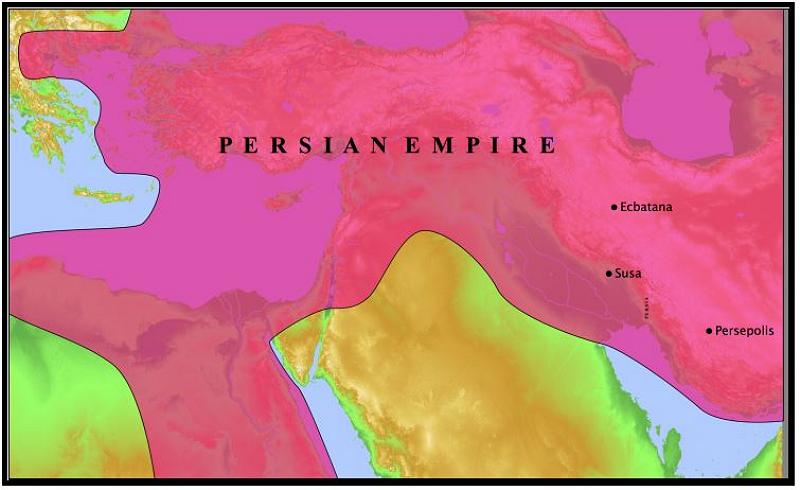
Persia had three capital cities: Susa (biblical Shushan), Ecbatana (150 miles north of Susa), and Persepolis (300 miles southeast of Susa). This formal gold wine cup comes from the royal palace at Ecbatana. The cast of a roaring lion displays the skills of a Persian artisan (550-332 B.C.). Ahasuerus, the king who chose Esther as his queen, probably drank from vessels similar to this at royal banquets described in the Book of Esther. This cup is currently in the Metropolitan Museum of Art.
 
 
When Ahasuerus came to power, Persia was already the largest empire in the known world and still growing. In the first year of the king's reign, he attempted to conquer Greece but suffered setbacks at Thermopylae, defeat in a navel battle at Salamis, and humiliation at Plataea.
 
The Book of Esther opens in "the third year" of Ahasuerus's reign (1:3). Esther did not become queen until "the seventh year" of his rule (2:16), evidently after the king had come back from Greece (479 B.C.). The Greek historian, Herodotus, specifically relates that, upon the king's return, Ahasuerus consoled himself by enlarging his harem. Because the events of the story and the characters, except King Ahasuerus, are still unknown from secular sources, many critics consider the book a work of fiction. A. Bentzen, author of Introduction to the Old Testament (Copenhagen, 1948, vol. 2, p. 192), for example, calls it an "historical novel."
 
Although archeology cannot prove the historicity of the Book of Esther, it supplies ample evidence pointing to the book's genuineness. The fact that there is no Hellenistic coloring in the narrative and that there are no Greek words, both features being characteristic of a later period, suggest a date at least before the late 4th century B.C. Bentzen must admit that "the story teller knows something of the administration of the Persian kingdom and especially of the construction of the Palace at Shushan," despite his contention that the book is nothing more than historical fiction.
 
Excavations show that "Shushan the Palace" (1:2) refers to the acropolis of the Elamite city of Susa, where magnificent ruins remain, recalling the splendor of the Persian kings. Between 1880-1890, French excavators uncovered Ahasuerus's breathtaking royal residence spread over two and a half acres. These explorers found so much treasure from the period of Xerxes (the Greek equivalent to Ahasuerus) that the Louve in Paris devoted two large rooms to the collection.
 
Significance for Biblical Studies: The Persian Cup from the royal palace the Book of Esther describes is one of the few places in the Old Testament that historians can restore accurately from excavation data, which helps to confirm the reliability of the biblical text. The gold cup is typical of the extravagant drink ware official celebrations there used.

For a pdf go here.

Monday, December 11, 2017

Digging Up the Bible: Messianic Apocalypse

DIGGING UP THE BIBLE
Important Archeological Finds that help Us Understand Scripture
Linda Manuel—1996
Messianic Apocalypse
(c. 100 BC)
The Messianic Apocalypse (4Q521) is a collection of fifteen leather fragments with three columns of Hebrew text. Originally called "On Resurrection," it is among the most intriguing of the newly released Dead Sea Scrolls (DSS). Abbe Jean Starky began the translation but died in 1988 before finishing. After Starky's death, Father Emile Puech of the Ecole Biblique in Jerusalem took over the work and is the present official editor.
 
Qumran cave 4, where most of the scrolls were found
The largest fragment, consisting of fourteen lines from column two, appears above and is translated below. The precise date of the text is uncertain, from 200 B.C.—70 A.D., though perhaps soon after 100 B.C.
 
This text, designated 4Q521 (document 521 from cave 4), reflects a close relationship to messianic belief among certain Jewish groups outside Qumran. The most well preserved part of this text are fourteen lines from column two. (In accord with scholarly convention, the parts in square brackets are reconstructed on the basis of surviving portions.):
 
A Translation of U521
  1. [...The hea]vens and the earth will obey his messiah.
  2. [The sea and all th]at is in them. He will not turn aside from the commandment of the holy ones.
  3. Take strength in his mighty work, all you who seek the Lord.
  4. Will you not find the Lord in this, all you who wait (for him) with hope in your hearts?
  5. Surely the Lord will seek out the pious, and will call the righteous by name.
  6. His spirit will hover over the poor, by his might will he will restore the faithful.
  7. He will glorify the pious on the throne of the eternal kingdom.
  8. He will release the captives, make the blind see, raise up the do[wntrodden .]
  9. For[ev]er I will cleave [to him ag]ainst the [po]werful, and [I will trust] in his lovingkindness
  10. a[nd in his] godliness forever. His] holy [messiah] will not be slow [in coming.]
  11. And as for the wonders that are not the work of the Lord, when he (i.e., the messiah) [comes]
  12. then he will heal the sick, resurrect the dead, and to the poor announce good tidings.
  13. ...he will lead the [holy] ones, he will shepherd [th]em. He will do
  14. ...and all of it...
Both Matthew and Luke state that when John the Baptist was in prison he sent his disciples to ask Jesus about the rabbi's messianic identity. Jesus' reply settles their suspicions:
Go back and report to John what you hear and see: The blind receive sight, the lame walk, those who have leprosy are cured, the deaf hear, the dead are raised, and the good news is preached to the poor. (Matt 11:4-5 = Luke 7:22-23)
These signs of the messiah apparently confirmed Jesus' messianic identity to John's disciples, because they left without further discussion.
 
Significance for Biblical Studies: The Messianic Apocalypse is like passages in Matthew and Luke, and it may represent a tradition within Palestinian Judaism one hundred years before Jesus' birth. It offers a comparison between the groups that fled into the wilderness to prepare "the way of the Lord" (Isa 40:3; Luke 3:4). They had similar expectations and drew on similar texts from the Hebrew Bible. 4Q521 provides an important example of common messianic hope among Jews, including followers of Jesus and John.

For a pdf go here.

Sunday, December 10, 2017

Digging Up the Bible: Merneptah Stele

DIGGING UP THE BIBLE
Important Archeological Finds that help Us Understand Scripture
pdf
Linda Manuel—1996

 
Merneptah Stele
(c. 1220 BC)
Pharaoh Merneptah, who ruled Egypt 1223-1211, commissioned this seven and a half foot monolith found in 1896 at his Thebes funerary temple. The monument, now in the Cairo Museum, recounts the pharaoh's battles with the Sea Peoples, invaders representing several different nations from Europe and Asia Minor. Another name for this granite piece is "The Israel Stele" (or stela) because it mentions a short campaign into Canaan, where Merneptah allegedly defeated a people called Israel.
 
 
The text contains the earliest reference to Israel and is indispensible for confirming biblical events for which there is scant or even no extra-biblical evidence:
The rulers lie prostrate saying 'peace;' none raises his head among the Nine Bows [Egypt's traditional enemies, by now a literary convention]. Plundering is for Tehenu [Libya]. Hatti is at peace. Canaan has been plundered into every sort of woe. Ashkelon has been overcome. Gezer has been captured. Yano'am was made non-existent. Israel is laid waste, (and) his seed is not. Hurru [Canaan] is become a widow for Egypt. All lands are united in peace.


When Merneptah took the throne of his father Ramses II (perhaps the pharaoh of the exodus), he was already elderly. Egypt was an empire in decline, and the myth of the invincible divine Pharaoh often led to exaggerated claims of military victories that cannot be substantiated by historical evidence. The boast of an Israel campaign is one such claim. Although history cannot prove the battle actually took place, the stele does show that Israel was a viable force in Canaan at the time.
 
The hieroglyphics include determinatives (signs indicating a word's category) that mark Ashkelon and Gezer as city-states; but the determinative attached to Israel identifies it as a people group, apparently not possessing a distinct location. In other words, Israel's status seems to be that of a nomadic collection of tribes rather than a settled population—the land is not yet theirs. These small details help to answer some historical questions, while other issues remain unresolved. For example, it took the nation more than forty years to get into Canaan but, once there, how long did it actually take to possess the land? Joshua was very old when God commanded him to divide the land among the Israelite tribes, and even then they had not completed the conquest.
 
Significance for Biblical Studies: The Merneptah Stele, with its specific citation of Israel, provides evidence of the people's presence in the land of Canaan at a time of great regional upheaval, having entered from the east as the Sea Peoples entered from the west.
 
For a pdf go here.

Saturday, December 9, 2017

Digging Up the Bible: Megiddo Altar

DIGGING UP THE BIBLE
Important Archeological Finds that help Us Understand Scripture
pdf
Linda Manuel—1996
Megiddo Altar
(13th century BC)
Tel Megiddo is widely regarded as the most important archaeological site in Israel today. (A Tel is an artificial hill or mound.) Researchers have uncovered twenty levels of civilization representing 5500 years of continuous habitation from 6000-500 B.C. The round altar there (2950-2350 B.C.) was the center for much of the city's religious activity. Seven steps (in the photo) lead to a huge platform twenty six feet in diameter and five feet high. Adjacent to it were three small temples, each assigned to a different deity. In some respects, this altar resembles the biblical "high places" which religious reformers in the 81h and 7th centuries condemned.
Megiddo was a major city and cultic center in Canaan. The culture of the Canaanites was not primitive according to the standards of its day. They had international trade connections throughout the Mediterranean, drew advanced architectural design and construction techniques from Egypt, and displayed intricate pottery decoration. (A small broken tablet found on the site containing a passage from the Gilgamesh Epic may indicate a scribal school in Megiddo.) Their religious practices, however, were morally depraved, including child sacrifice, fertility rites, and sexual perversion, all of which God considered detestable. He instructed Israel to destroy the Canaanites, but His people failed to complete the task. Israelite forces did not conquer Megiddo until long after the initial incursion:
Manasseh did not drive out the people of Beth Shan or Taanach or Dor or Ibleam or Megiddo and their surrounding settlements, for the Canaanites were determined to live in that land. (Judg 1:27)
Most scholars date its capture to the time of David, several hundred years later.
The book of Leviticus gives detailed instruction on ceremonial law and lists warnings and condemnations of Canaanite cultic practices:
The LORD said to Moses, "Speak to the Israelites and say to them: 'I am the LORD your God. You must not do as they do in Egypt, where you used to live, and you must not do as they do in the land of Canaan, where I am bringing you. Do not follow their practices.... "Do not defile yourselves in any of these ways, because this is how the nations that I am going to drive out before you became defiled. Even the land was defiled; so I punished it for its sin, and the land vomited out its inhabitants. But you must keep my decrees and my laws. The native-born and the aliens living among you must not do any of these detestable things, for all these things were done by the people who lived in the land before you, and the land became defiled. And if you defile the land, it will vomit you out as it vomited out the nations that were before you. (Lev 18:1-3, 24-28)
Despite this instruction, Israel allowed some pagan religious centers to remain, and these eventually led the nation away from God.

Later in Israel's history, God used the Assyrians to take the ten northern tribes into exile because of their involvement in these corrupt practices. The southern tribes also adopted Canaanite rites, and God sent them into exile through Babylon. Leviticus calls God's people to be holy in every aspect of life. Holiness cannot coexist with evil or depravity, a point believers would do well to remember even today.

Significance for Biblical Studies: The Megiddo Altar is a reminder of why the Northern Kingdom of Israel went into exile and of the devastating effect idolatry had on the nation:
All this took place because the Israelites had sinned against the LORD their God, who had brought them up out of Egypt.... They worshiped other gods and followed the practices of the nations the LORD had driven out before them, as well as the practices that the kings of Israel had introduced. The Israelites secretly did things against the LORD their God that were not right. From watchtower to fortified city they built themselves high places in all their towns. (2 Kgs 17:7-9)
For a pdf go here.

Friday, December 8, 2017

Digging Up the Bible: The Manachem Seal

DIGGING UP THE BIBLE
Important Archeological Finds that help Us Understand Scripture
pdf
Linda Manuel—1996
Manachem Seal
(late 1st century AD)
This bulla was one of several clay seals (bullae) that was part of a cache in Jerusalem, having survived the burning of the Jewish capital by Roman troops in A.D. 70.


While the survival of many seals, which once marked correspondence (since destroyed), have a simple design unique to the author, this particular seal has the name of its author: "Achiav ben [son of] Manachem."

Menachem appears in the biblical text as a monarch from the Northern Kingdom of Israel: "In the thirty-ninth year of Azariah [Uzziah] king of Judah, Menachem...became king of Israel, and he reigned in Samaria ten years. (2 Kgs 15:17). Archav resembles another Israelite king: "Ahab...became king of Israel, and he reigned in Samaria over Israel twenty-two years" (1 Kgs 16:29). Although the seal chronology of these individuals (i.e., Achiav after Manachem) does not match their relative reigns (i.e., Menachem after Ahab), the appearance of these names shows their popularity in Jewish society.

Seals were an important part of official correspondence, helping to ensure the secrecy and integrity of a letter's contents:
"[Jezebel] wrote letters in Ahab's name, placed his seal on them, and sent them to the elders and nobles" (1 Kgs 21:8).
This whole vision is nothing but words sealed in a scroll. And if you give the scroll to someone who can read, and say to him, "Read this, please," he will answer, "I can't; it is sealed." (Isa 29:11)
"I took the deed of purchase—the sealed copy containing the terms and conditions, as well as the unsealed copy" (Jer 32:11).
Multiple seals on a single document marked additional security or a document the recipient should open in stages:
I saw in the right hand of him who sat on the throne a scroll with writing on both sides and sealed with seven seals.... The Lamb opened the first of the seven seals. The Lamb opened the second seal.... The Lamb opened the third seal.... The Lamb opened the fourth seal.... He opened the fifth seal.... He opened the sixth seal.... He opened the seventh seal.... (Rev 5:; 6:1,3,5,7,9, 12;8:1)
Significance for Biblical Studies: While the Manachem Seal does not confirm the historicity of any particular king, it shows the popularity of these names and demonstrates how people in 1st century Judaism secured their correspondence.
For a pdf go here.